
By Keith C. Milne
While growing up, I was always fascinated with skydiving. I remember being riveted to the television while watching any shows or movies that included skydiving. I always got the same jolt every single time I watched someone jump out of an airplane with only their wits and a chute on their back.
Watching them leave the plane, often off of a lowered midsection ramp used for loading cargo, they would simply walk up and then step off or jump outward and off the end of the ramp, rapidly accelerating to 120 mph towards the Earth. It really excited me to imagine doing that myself. When I became a little older as a teenager, I knew that skydiving was somehow going to be in my future, I just had to figure out the details, then summon up courage enough to do it!
As I grew older, that interest and curiosity grew stronger, and I began to feel more powerfully drawn to want to become one of “those people,” the ones that actually walk the walk and face their own fears head on and enjoy their lives doing the things they find interesting and exciting, rather than just sitting on the sidelines dreaming about doing those things, but never acting on any of them.
Me? I finally grew tired of wondering how it would be or feel to jump out of an airplane! I wanted to know once and for all! “After all, LOTS of other people do it all the time–actually every single day with quite a low incident rate, especially compared to automobile transportation statistics,” I remember thinking.
Like any strong, healthy, young man I had learned enough along the way already to know how to make healthy decisions for myself, and I had also witnessed how well making wrong choices had panned out for a few acquaintances, so I decided that, for me, the best way to proceed was to do a little more research and then proceed slowly but surely.
At this particular period in time, the early 1990’s, was just the beginning of the internet as we know it today, and no businesses except a handful had a website yet, so it meant actually making phone calls to small, local airports in order to finally locate a suitable starting place for my new resolve to jump out of a perfectly good airplane at least once in my life. I knew as sure as I was breathing that if I didn’t get this adventure out of my system that I would regret not doing it while young and still brave and fit enough to go for it.
In true baby-step fashion, I decided to get started by going for a “static-line jump.” It is called a “static-line jump” because the primary parachute handle is tethered with a steel cable and a special release hook that is attached to a static anchor inside the plane at the other end. The cable is long enough so that the skydiver can move out onto the wing in order to get into position before releasing. When the jumper releases and leaves the plane, the slack reaches its limit in milli-seconds, and the parachute is released for the jumper when the cable pulls the ripcord for the skydiver.
Training was quick and specific. Three main areas of emphasis:
Practice getting into the plane, a single engine Cessna, with one seat for the pilot and open with seats removed in order to accommodate 4 jumpers along with the pilot or 5 total. The process leaves everyone facing forward, the first person in goes behind the pilot, then the second next to them. The first in will now be the last one out.
The second part of the training is how to exit the plane, which needs to be done in a systematic and methodical order, beginning with the person next to the passenger hatch up front next to the pilot. That person also acts as the lookout for the pilot, and helps guide the pilot position the plane so that we will be able to exit the plane slightly downwind from the target landing area. Doing so keeps the wind into or towards a deployed parachute, better enabling it to be lifted and keep it filled with air to maximize the amount of time that the skydiver has to steer to the landing target.
The third part of the training consisted in having us practice reaching across our chest using our right arm to “pretend grab” the handle for the secondary, reserve parachute in case the primary one failed to open upon exit. With emphasis placed on how quickly we would need to do this because we would be exiting the plane at such a low altitude. Static-line jumps are to familiarize a person with the whole experience without taking them up to the dizzying heights involved in free-falling, the downside being that if something goes wrong with the first chute on exit, you only have about one second to take corrective action, because you’re leaving the plane at a lowly 3000 ft. altitude! Learning this, I knew, eyes-wide-open when I went up that first time that if the first chute didn’t open, I was going to quickly become a human pancake.
Nervous doesn’t come close to how I felt on my way to the little airport in Suffolk, VA where I first left a plane with nothing more than my own wits, a silent prayer, and my chute(s). But, for my first jump, I was going to be the first, and only one out at 3000 ft. because the rest of the jumpers that went up with me were all going up to 10,500 ft. for a free fall jump experience.
The plane droned it’s way up in a semi-tight circular path until getting up to 3000 ft. then it leveled off, slowing down to 90 mph, the slowest it could go and still keep all of us in the air safely.
The more experienced jumper opened the passenger hatch. The air inside the cabin exploded, and the engine noise was deafening. He moved over closer to the pilot, turning somewhat sideways, allowing me to hook up as I had been shown in training earlier that same day, and then begin my exit by moving myself out onto the right wing strut of the airplane.
Once I inched my way over to the open door and turned to face the hatch, I reached out with my left hand to grasp the wing strut close to where it connects to the body of the plane. Then, in one motion, with my right foot pushing off of the doorway, and while still grasping the wing strut with my left hand, I lurched out to grasp the same wing strut with my right hand, then let my feet trail behind me hanging freely in the wind.
Once I had fully exited the plane, I was hanging off of the right wing strut by both hands and the pilot and I were now making eye contact. As rehearsed, once I was sure I was ready to go, I nodded at the pilot, he smiled, nodded back, gave me a thumbs up, and I let go!
I remember thinking “This is it!” right when I let go. Much to my surprise and disappointment that day, and for the next two jumps I made at Skydive Suffolk, I only felt a sudden feeling of acceleration for about a milli-second! I later learned that it was, in part, because I was only doing static line jumps, and my chute was being deployed slowing me down before my acceleration could begin!
All three times I went for static-line jumps, I had the same experience of the whole thing being over way too soon. Even by the second jump, I already knew what to expect and, having seen others do free falls right over the landing field while I was there for my jumps, I was already seeing my jumps as kind of ho-hum or even a little wimpy in comparison. Not only that, but I was even more intrigued watching these guys go up and exit the plane so high that they looked like carpenter ants coming out of a nest in the sky.
Suddenly, there would be one, then three seemingly all at once appearing next to the plane, and you could see them kind of scrambling to find their way and get into a good free fall position, then separate a little and free fall, and one by one they would deploy their chutes and steer their way back to the landing zone and often land right in front of me, doing a hard flare and maximum toggle to slow down at just the right moment, and then simply fast-step or light jog to finish, still standing up!
After witnessing this a few times, I knew in every fibre of my being that I would not be satisfied or consider myself a bonafide skydiver until I actually free fell from a plane on my own, deployed my own parachute, and landed safely within reasonable proximity to the airfield and designated landing zone. That was my next level or step in my journey to fulfill my lifelong fascination with and excitement about skydiving.
I was as excited as a kid at Christmas driving west early one morning on I-64 heading towards Richmond on my way to receive my first all-day training and subsequent free fall from 10,500 ft. at Skydive West Point! A couple of people at Skydive Suffolk that I met on one of my static-line jumps had mentioned that they preferred Skydive West Point to Suffolk. I called West Point and loved what I heard, which was that they had 3-5 instructors on weekends that were all used to working together, collectively had jumped 1200 or so times in various skydiving competitions around the country, as well as having small, medium, and large planes for jumping, top shelf equipment, and reasonable prices.
The training was interesting, fun, and then became a little grueling as the day wore on. How to put on a free fall suit with help, how to do every single part of every single thing, then do them all again, and then again, and then one more time just for good measure. Useful stuff though and I later learned just how useful when we finally went up for that first jump.
I was surprisingly afraid going up for my first free fall sky diving experience, even though I had already familiarized myself with the sport somewhat by doing three static-line jumps!
We were like packed sardines into that little single engine Cessna. As we taxied down the runway, Ruth, one of the jump masters let me know that I would be the second to last one out just as we had practiced all afternoon. The rest of the crew inside the little Cessna single engine plane consisted of the unnamed pilot, the camera guy Weston, then Dave the head jump master, and me. They were all very relaxed and talkative on the way up, smiling and laughing and keeping it light. I played it cool, but as the plane ascended, I could feel my internal paralysis growing by the second, and I had to fight from panicking.
I remember briefly imagining myself not going through with it. I remember a little voice saying to me, “Oh, don’t worry. If you really don’t want to go through with it, then it won’t be a big deal. Not everyone is cut out to do things like this. Since you’ll be the last one out, you can tell them to go ahead and enjoy a jump while you fly back to the landing strip with the pilot!” a brief pang of comfort rifled through me realizing that it wasn’t too late for me to change my mind. Then, just as fast, I came to my senses and got angry at myself for even letting those thoughts into my mind at such a critical time.
Now my self-talk dialogue became “How dare you give up and chicken out now!! After decades of watching others do this, and decades of fantasizing about doing it, you are here! This is it! YOU ARE FINALLY GOING TO FALL NEARLY 2 MILES TOWARDS THE EARTH AT 120 MPH! You’ve already completed three static line jumps. You’ve spent all day training and being taught what to do and when to do it! Dude!” I knew that this was my personal moment of truth about facing my fears in order to fulfill a personal dream of mine, to jump out of a perfectly good airplane and live to be able to remember it and tell others about my experience before dying. The rubber was about to meet the pavement. I swallowed hard and kept watching the roads and buildings below grow smaller by the second.
About halfway up to the preferred altitude of 10,500 ft., a calmness seemed to envelope the cabin. Thousands of small, puffy, white clouds as far as the eye could see pockmarked the razor sharp blue sky. I suddenly realized that, if today was my day to die, then it was unlikely that I would be able to do much about it, but that the opposite also held true. If it wasn’t my day to die, then I had absolutely nothing to worry about whatsoever. That idea further expanded and became bigger and then I saw that my insight was universal, that the control all of us think we have over our lives is only an illusion. We do not know when or how we will die, nor do we have any real control over incidents involving outside variables like automobile accidents, or weather-related accidents, things brought to us by others, or simply conditions beyond our control. Those things can, and do happen independent of our choices to eat right, exercise, and the like. In other words, I realized that I NEVER REALLY HAVE ANYTHING TO WORRY ABOUT AND THAT WORRY ITSELF WAS A HUGE WASTE OF MY TIME. It was an incredible insight, and was driven home by the setting, the heightened mood, and what we were all about to do.
The tone of the engine lightened up as we leveled off. Dave actively looking out of the passenger hatch. He shouted, “CUT IT,” and the pilot slowed us down to 90 mph, slow enough for us to get out of the plane, fast enough to keep it aloft. Dave unlocked the latch and slid the door all the way open. As always, the air inside the cabin exploded for a brief moment, going from nearly quiescent to the equivalent of riding on the back of a motorcycle on an uncrowded country highway in 1 second. As soon as he finished negotiating with the pilot in order to get us well positioned for a jump, he looked around and asked us, “All set!?” Everyone including myself nodded affirmatively.
Westin, with video cameras mounted on his chest and helmet, was the first out. I was blown away watching him exit! We had gone over that he would exit first in training, but watching it close up in real time, with a 90 mph headwind blasting away at him, trying its damndest to peel his jump suit off, he managed to slide past Dave, sat down on the edge of the hatchway, turned and gripped the two handles to his right one with each hand, then scooted off into the wind and let himself get whipped backwards at high speed, ending up hanging off of the hatchway door on the outside of the plane and facing forward horizontally, like a human flag waving in the wind, calmly waiting for the rest of us to exit!
Your Turn!
Once Westin was safely in place, Dave immediately turned, reached out with his left hand, quickly followed by his right, leaning hard into the wind and making his move so quickly that the whole sequence happened as if done in a single motion, and just like that, he was on the wing strut. He quickly continued hand walking out all the way to the end of the wing strut, then stopped and looked back at me, waiting for me to exit. I had already moved myself into position close to the hatch as I had been taught, in order to minimize how long everyone outside already had to hang on in a 90 mph wind.
Once at the hatch, I sat with my feet facing forward. The ninety mph blast was mostly moving past me. I looked down in order to verify the location of the step that I would place my right foot onto briefly while pushing out to the wing strut, and took my first look at the two miles of air between myself and the Earth. Manmade objects, moving vehicles, and building looked tiny and very far away. I felt my heartbeat in every cell of my body, but fought back hard against the urge to freak out. I took in a huge, deep, breath and, while letting it out, made my move to the strut.
The ninety mph blast seemed stiffer than I remembered, but it had been almost two years since my last static-line jump. I was pleased with my exit. No mishaps, slips, falls, mistakes, or missing a grip or anything like that. Once on the strut, I too, moved over about six inches right about the time Ruth exited quickly and efficiently, grabbing the wing strut on my left.
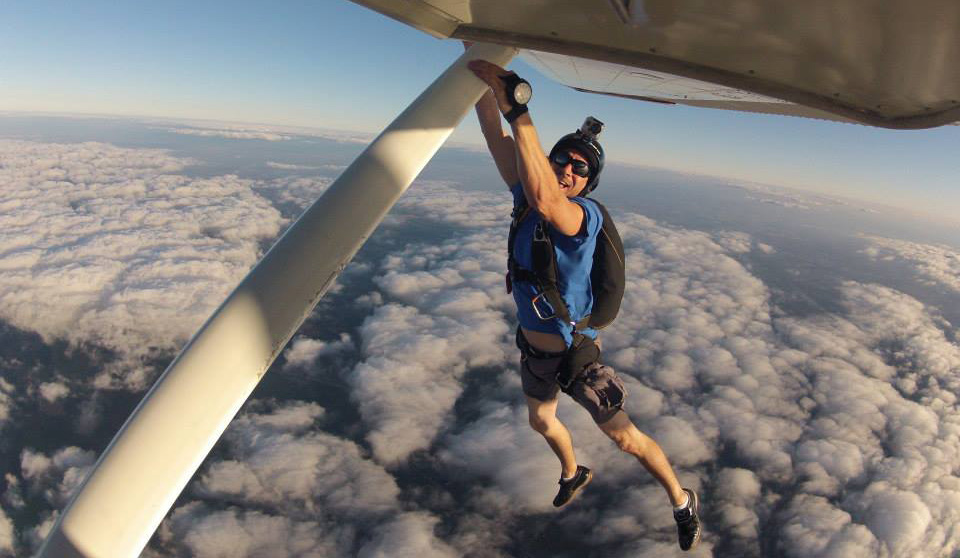
Now we are all on the outside of the plane. I make eye contact with Dave and nod. He nods back, and we all begin a 3 count bounce, with all of us pulling on the strut slightly to bob up and down a little while counting out to 3, and then we all let go at the same time, with Ruth having a hold of me on my left side, and Dave hanging onto my jumpsuit on my right side, which is standard protocol to have one jump master on each side of the newbie on the first several free falls.
Almost Stable!
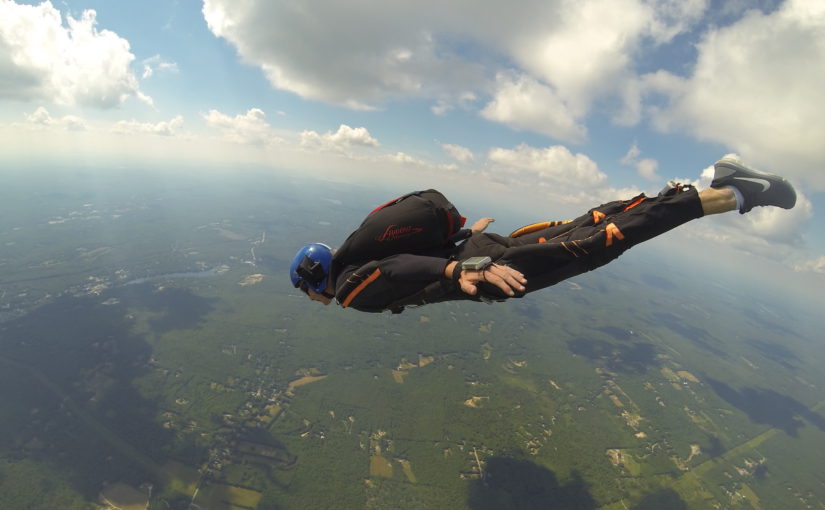
While getting into free fall position by doing a hard backwards arch with my hands up on either side next to my head, I FINALLY FEEL THE FEELING OF HYPER ACCELERATION that I have fantasized about for decades, but it is still far more fleeting than I anticipated. I feel like I’m being sucked or pulled really hard and fast into a bottomless pit or black hole for about two seconds! Two seconds after hyper-accelerating, the friction from the air that I’m falling through is enough to eliminate that sinking sensation, and morph it into a feeling of floating!
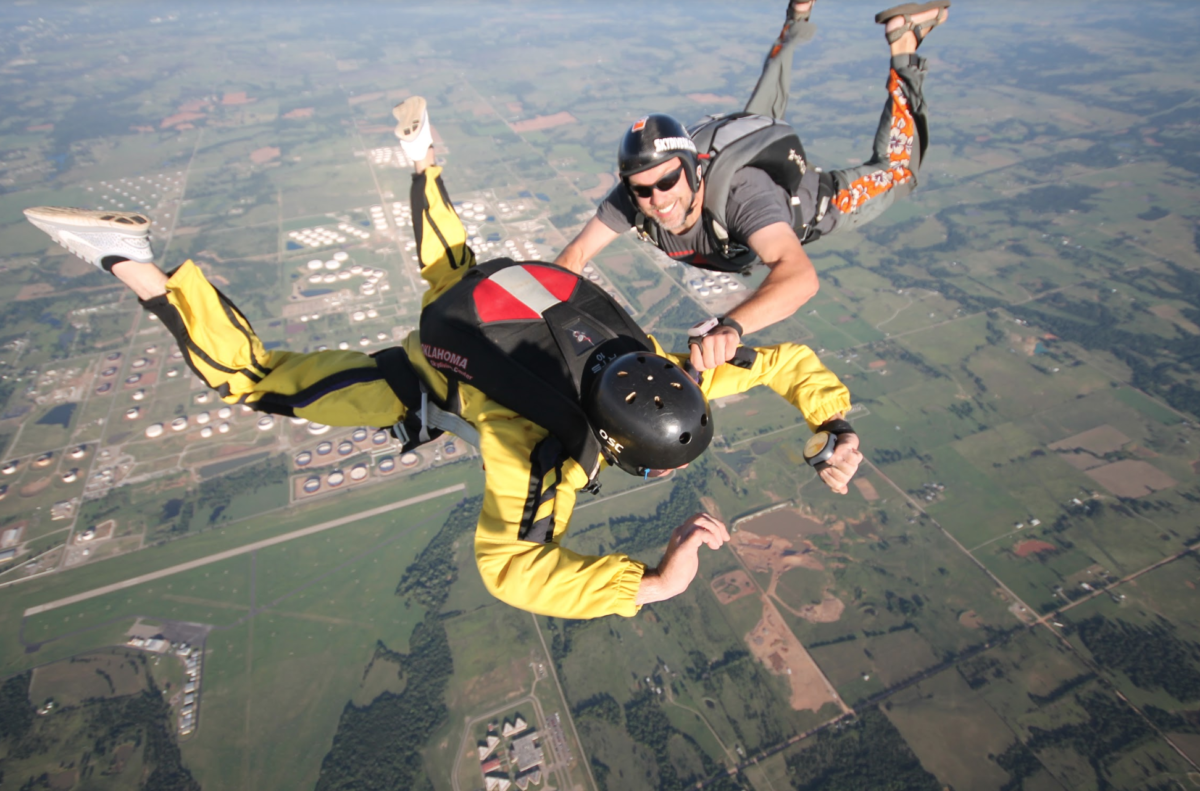
Across from me Westin was smiling at me with an ear-to-ear grin with the camera aimed right at me. I could see how the air passed through his jump suit trying desperately to rip it off of his body. Seeing the air tugging at his clothes was all the visual indicator I needed to re-inform me of my own speed of descent as I continued plummeting towards the Earth at terminal velocity and it shocked me a little bit.
In the short time that I fell, I could see the slight curvature of the Earth as I looked towards the distant horizon. The manmade structures and roadways looked fragile compared to the Earth around them, almost as if the walls were expending nearly all of their energy in order to hold back the outside world and keep nature at bay. As my descent continued and my altimeter indicated that I was fast approaching 7800 ft., suddenly everything became gray steam and the humidity went off the charts as we fell right through one of the puffy clouds I had seen while ascending for our jump.
A second later I was back out in the bright sunshine and there was Westin, still looking like a plastic military action figure dressed up in a skydiving outfit, and the manufacturer had made this model with a permanent smile moulded onto his face which was effectively used to confuse others.
Seconds after clearing the cloud, we were all at the magic rip-cord pull zone of 5000 ft. If you pull you chute at this altitude and it malfunctions, at least you still have a fighting chance to pull your reserve and have it save your life. I pulled my ripcord and looked up to watch it deploy. I felt the jolt of it rapidly unfurling as it ascended above me perfectly and opened right up.
Beginners all get the biggest parachutes, the ones they call “9 cell chutes,” because they have 9 distinctly sewn columns that are sewed together to form a canopy. They are open in the front to catch air, but closed in the rear in order to keep that air from escaping. This helps keep the cells inflated with forward motion and helps maintain a slower descent. The other members of my crew that day all had 7 cell chutes, so their descent was faster, especially when they used their own more advanced techniques to hasten their descent in order to get down the the ground and coach me with the rest of my descent. Since we all had two-way radios baked into our helmet’s, it was easy to hear the instructions from below used to help me steer myself to the landing zone, where I proudly accomplished a nice, slow, stand-up landing on my first free fall sky dive experience!
I was so amazed, and thrilled, and JACKED UP WITH ADRENALINE! I felt FANTASTIC and I immediately wanted to go up and do it again! That excitement stayed with me for the rest of that afternoon driving home, and kept going strong while trying to relax later that night, which I couldn’t do! I couldn’t stop thinking about what I had just done. I kept replaying the experience over and over again in my mind, and recreating my adrenalized reaction to it!
I went back two more times before running out of money and other obligations also came up that prevented me from continuing with it.
I ended up learning how to turn with both jump masters still attached to me while falling on my second free fall, and was finally untethered and allowed to free fall unaided on my third jump.
It was sad to stop, but I felt that I had done it enough to have really experienced it. I debated with myself for quite a while as to whether or not I wanted to keep jumping in order to finish the last 4 tests of the 7 that need to be completed satisfactorily, including a night jump, in order to qualify to get a jumpers license issued by the United States Parachute Association. However, at hundreds of dollars each time I went, and then having to go frequently enough to be considered “current” in practice, I let it go and chalked it up to having accomplished a bucket list item in a very thorough way, and I have never looked back with any regrets.
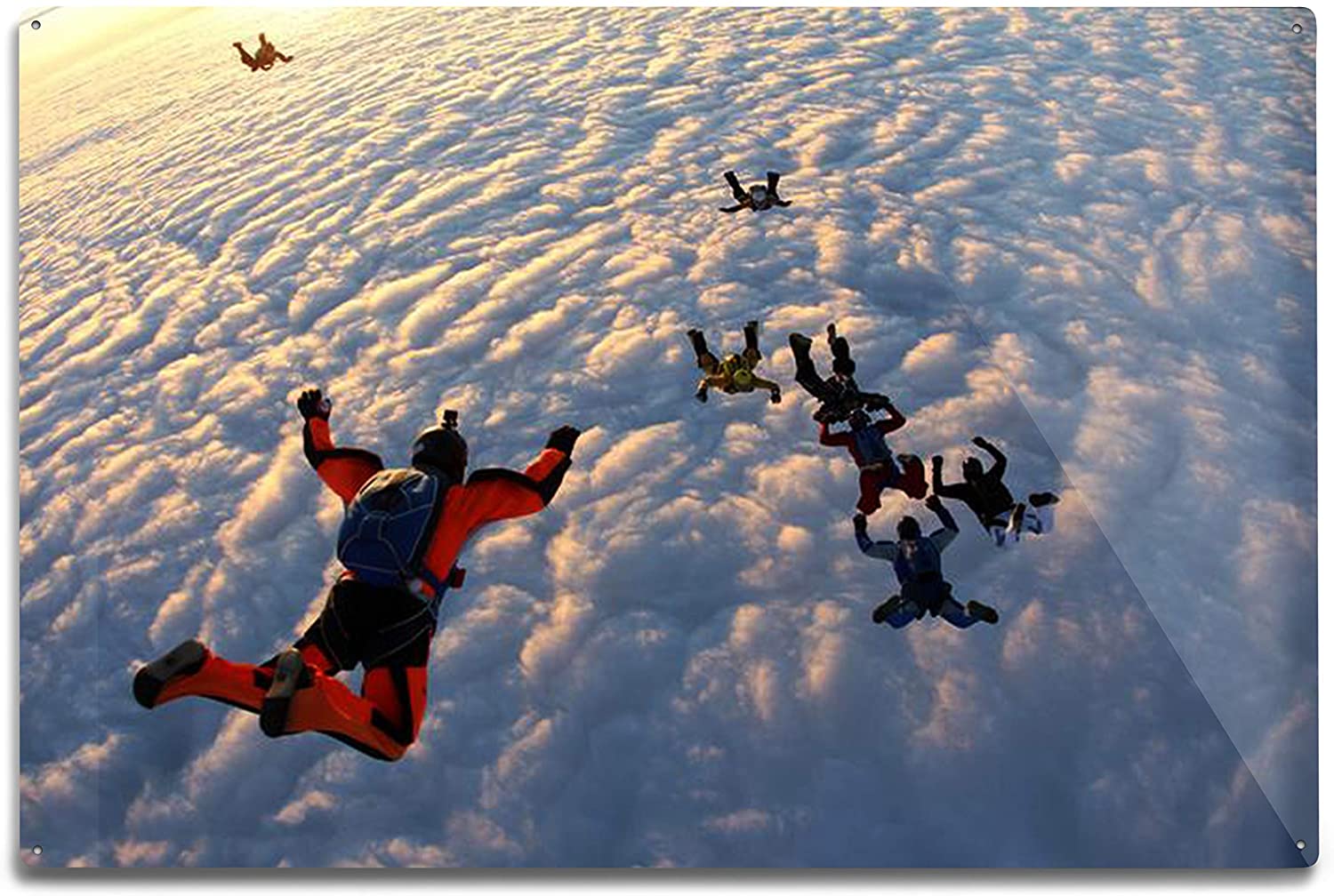
A few years later, I learned that Dave, Ruth, Weston, and the Pilot that I had gone up with had been a part of a very large group of jumpers that were all practicing group formations to get ready for a skydiving competition, and died as a result of an unexpected mechanical malfunction on their plane. Apparently, the plane developed the problem at a low altitude of barely over 500 ft., not nearly enough altitude for anyone to be able jump out, as their parachutes would not have had adequate time to deploy.
Leave a Reply